SuperSeller Blog
AI Chatbot vs Live Chat for Ecommerce: Which One Should You Use?
AI chatbot and live chat are not enemies. For ecommerce, the best setup usually automates repetitive questions and keeps humans for edge cases.
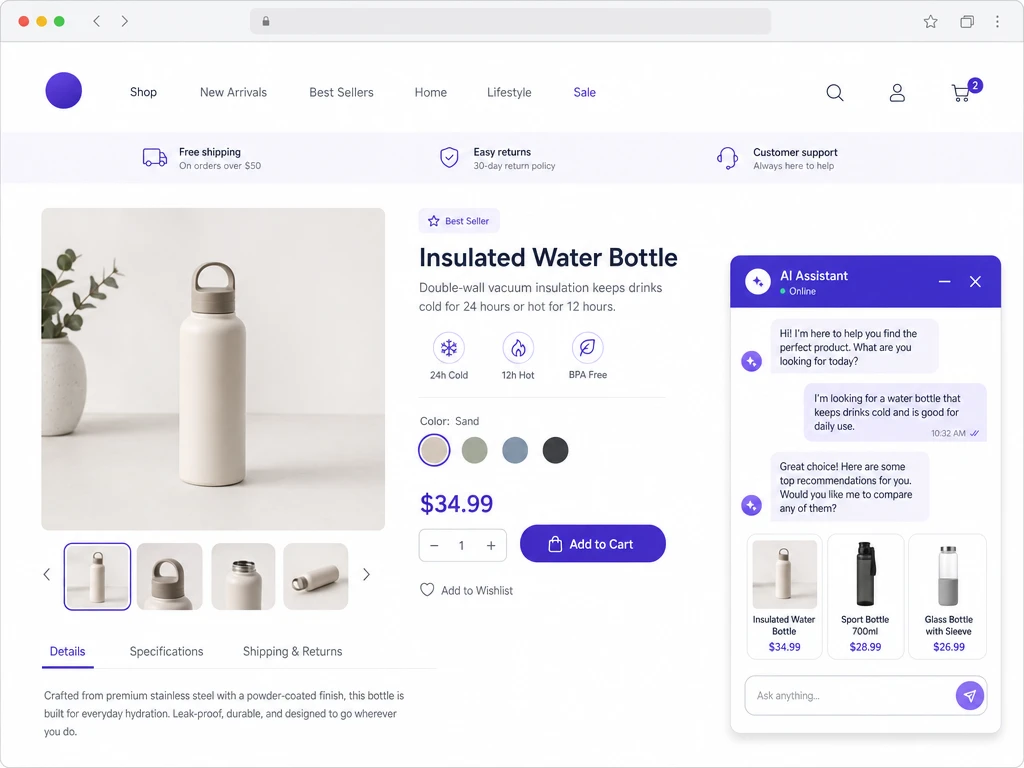
For ecommerce stores, the AI chatbot vs live chat question is usually framed the wrong way. The better question is: which conversations should be automated, and which ones still need a human?
Live chat is excellent when a customer needs judgment, empathy, or an exception. AI chat is excellent when the same question appears 40 times a week and the answer already exists in your product catalog or store policy. Treat them as different tools, not enemies.
Where AI chatbots win
- Repeated shipping, returns, warranty, and payment questions
- Product discovery and product comparison questions
- After-hours pre-sale support
- Multilingual first responses
- Capturing recurring gaps in product content
The biggest ecommerce win is not simply "fewer tickets". It is faster product discovery. A shopper who cannot find the right item on mobile can ask the assistant: "I need a waterproof backpack for a 15-inch laptop under 120 EUR." A live agent can answer that, but not instantly for every visitor at midnight. An AI chatbot can search the catalog, compare options, and point the shopper to specific products.
AI also works well for policy answers that do not change from customer to customer: delivery countries, return windows, warranty terms, payment methods, size guide explanations, care instructions, stock questions, and product compatibility notes.
Where live chat still wins
- Refund disputes and emotional support cases
- Custom enterprise orders
- Account-specific issues that need private customer data
- Negotiations or exceptions to policy
Humans are still better when the answer is not just information. If the customer is angry, if money is disputed, if the case needs access to private order details, or if you need to bend a policy, live support should take over.
This is especially important for trust. A chatbot should not pretend it can approve a refund exception or solve a payment dispute if it cannot actually do it. The right behavior is a clear fallback: collect the context, explain what happens next, and route the case to the team.
The best ecommerce setup
Use AI for the repetitive 70-80% of questions and route the complex cases to humans. That keeps response times fast without pretending automation can solve every support situation.
A practical hybrid setup looks like this:
- AI answers first for product, shipping, returns, warranty, sizing, and compatibility questions.
- AI recommends products when shoppers describe budget, use case, preferences, or constraints.
- AI asks a clarifying question when the shopper's request is too broad.
- AI routes to humans when the case involves refunds, account data, complaints, or exceptions.
- Your team reviews analytics to improve product pages and knowledge base entries.
This keeps live chat for the conversations where humans actually add value. It also means your support team stops answering "Do you ship to Germany?" for the hundredth time and spends more time on cases that need judgment.
Cost comparison: seat-based support vs conversation automation
Live chat usually scales with people. More chats mean more agents, longer queues, or worse response times. AI chat scales differently: the cost is tied to conversations and usage, while answer speed stays close to instant.
That does not mean AI is always cheaper in isolation. The real calculation is support time plus missed sales. If a shopper leaves because nobody answered a product question after hours, that loss does not show up as a ticket. A product-aware chatbot can recover some of that demand by answering before the buyer gives up.
What AI needs to work well
An ecommerce AI chatbot is only as useful as the store context behind it. Before judging the channel, check the inputs:
- Product descriptions are detailed enough to compare products
- Prices, stock, categories, and image URLs are synced
- Shipping and return policies are in the knowledge base
- Fallback behavior is clear when the answer is missing
- Analytics show failed questions so the team can improve content
If those pieces are missing, the chatbot will sound generic. That is not a live chat vs AI problem. That is a content and data problem.
What to measure
Track resolved repetitive questions, product recommendation clicks, fallback rate, support escalations, and the questions customers ask most often. Those metrics tell you whether automation is helping or just hiding problems.
Good ecommerce metrics include:
- Fallback rate: how often the assistant cannot answer
- Recommendation clicks: whether shoppers engage with suggested products
- Escalation rate: which topics still need humans
- Top repeated questions: what your product pages or policies fail to explain
- After-hours conversations: demand that live chat would have missed
When to choose AI chatbot first
Choose an AI chatbot first if your store gets repeated pre-sale questions, has a catalog that requires guidance, sells across time zones, or wants product recommendations inside the chat experience. This is common for fashion, electronics, beauty, home goods, sports, parts, and specialty retail.
When to choose live chat first
Choose live chat first if most conversations are high-touch, emotional, account-specific, or custom. Examples: luxury consultation, complex B2B quotes, refund-heavy support, or products where buyers need negotiation rather than discovery.
FAQ
Is an AI chatbot better than live chat for ecommerce?
For repetitive product and policy questions, yes. For refunds, disputes, and exceptions, humans are better. Most ecommerce stores get the best result by combining both.
Can AI reduce support tickets?
Yes, especially tickets about shipping, returns, warranty, payment, sizing, product comparison, and basic product availability.
Should I remove live chat after adding AI?
No. Keep a human path for complex cases. The goal is to protect your team's time, not hide your team from customers.
Related: see how automated ecommerce customer support works with SuperSeller, compare product recommendation chatbot use cases, or review SuperSeller pricing.
Related reading
- SuperSeller as a Tidio alternative — if you are weighing a live-chat suite against an AI-first assistant.
- SuperSeller as an Intercom alternative — flat pricing versus seats plus per-resolution fees.
- Best AI chatbot for WooCommerce — criteria that matter when choosing.
- AI Chatbot for E-commerce: The Complete Guide (2026) — the full picture: features, pricing models, and rollout.